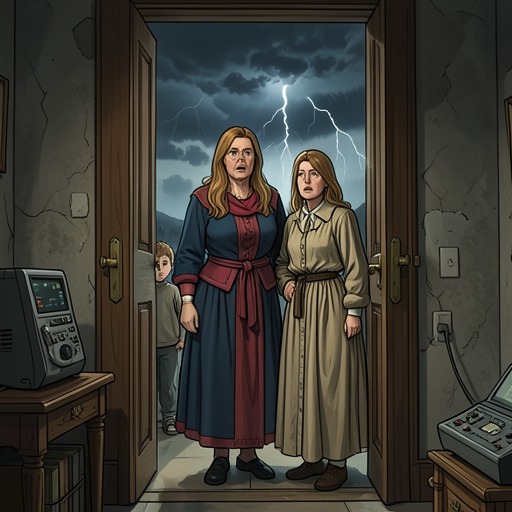
Elena Ochoa
Legado en los huesosElena Ochoa is a former intimate friend of Rosario Iturzaeta and a crucial witness to the period when Rosario became fascinated by a secretive group devoted to magic and witchcraft. Elena’s account to Amaia Salazar traces how a social circle that began as an apparently harmless experiment grew more disturbing, and how Elena’s refusal to accept its rituals ended a friendship she had valued deeply.
Friendship with Rosario
Elena says that when Rosario arrived in the area, the two women became inseparable. They walked together, cared for their children, went shopping and to the park, and, above all, talked. Elena had a daughter about the age of Rosario’s eldest, and she recalls that she had few other friends. Their closeness makes the eventual rupture more than a disagreement over beliefs: Elena describes losing someone she loved and hoping for years that Rosario might change her mind.
The friendship did not end as soon as Rosario joined the group. Family members later recalled that relations initially continued well: Rosario visited in summer with her older daughters, and the family visited her too. One relative places the change around the death of Rosario’s baby. That recollection situates the estrangement in the broader family history, though Elena’s own account identifies the group’s sacrifices and Rosario’s reaction to her objections as the immediate cause of their break.
The Group and Its Escalation
Elena describes the meetings as taking place at a farmhouse under the guidance of an attractive, well-dressed, persuasive man whom the members called their teacher. She did not know whether he had any professional qualifications. The group was presented as a movement for bodily and emotional expression, combining relaxation, tantra, yoga, and meditation. Early conversations about UFO sightings, abductions, and astral travel gave way to a narrower interest in witchcraft, magical symbols, and the valley’s history of witchcraft. Elena found this turn less appealing; Rosario, by contrast, was fascinated by the secrecy and sense of belonging.
The rituals became harder for Elena to accept when the members began sacrificing animals. She distinguishes these acts from the ordinary killing of livestock on a farm: the group treated the animals as sacrifices, collected their blood in wooden bowls, and stored it in bottles with an ingredient said to keep it liquid. Elena says the blood assumed an excessive importance in the group’s practice, and that she was already frightened by what she had seen.
The teacher announced that a dozen people, men and women, from Lesaka would visit to help the members complete their training and reach a higher level. They spoke repeatedly of El Sacrificio as something set apart from ordinary offerings. Elena recounts that one man explained the distinction as a human sacrifice, rather than the sacrifice of a cat or lamb. She had heard old stories about witches killing children as offerings, but had regarded them as superstition; now she searched newspapers for reports of dead or missing children. Finding none did not reassure her enough to stay.
The Break and Its Aftermath
Elena took her concerns to Rosario and urged her to leave the group. Rosario reacted furiously, insisting that Elena did not understand the importance of their work or the power they discussed. She called Elena a traitor. Elena concluded that Rosario had been brainwashed, left the meetings, and, for months afterward, received reminders from the group. Her testimony establishes what she heard and feared, not independent confirmation that the human sacrifice had occurred: she says she never fully believed the teacher’s announcement and found no matching news reports.
The separation endured for many years. By the time Amaia came to see her, Elena and Rosario had not spoken since their falling-out. Flora directed Amaia to Elena’s house, identifying her as someone who had known their mother especially well, but warned Amaia to treat Rosario respectfully. Elena initially emphasizes the grief of losing the friendship and explains that the two women had been close before Amaia was born. Her disclosure therefore comes from affection as well as alarm: she remembers Rosario as a friend while describing the beliefs and actions that made continued friendship impossible.
Testimony and Narrative Significance
Elena’s account gives Amaia a personal history unavailable in the family’s official records: the gradual shift from wellness practices and occult conversation to blood rituals, the teacher’s claim about a human sacrifice, and Rosario’s anger when challenged. Its evidentiary boundaries matter. Elena reports the group’s language and her own response, including her unsuccessful newspaper search; she does not claim to have witnessed a human killing. The distinction keeps the testimony both consequential and uncertain.
Her role is also shaped by the long silence between the former friends. The information reaches Amaia only after Flora makes contact and Elena agrees to receive her, with Flora’s warning still hanging over the conversation. Elena’s memories reveal a past intimacy and a decisive rupture at once: the same closeness that made the loss painful gives her account its value as a window into Rosario’s earlier life.